
Before entering a new market, many multinational corporations quietly rely on Hofstede’s Cultural Dimensions Theory as a strategic compass. While you rarely see companies publishing “Hofstede case studies,” a closer look at their market strategies often reveals a subtle but deliberate alignment with the framework’s insights.
Developed by Dutch social psychologist Geert Hofstede, this theory maps how a society’s culture shapes its members’ values, and, in turn, their behaviors. In business, these cultural patterns can make the difference between a product that flops and one that resonates deeply.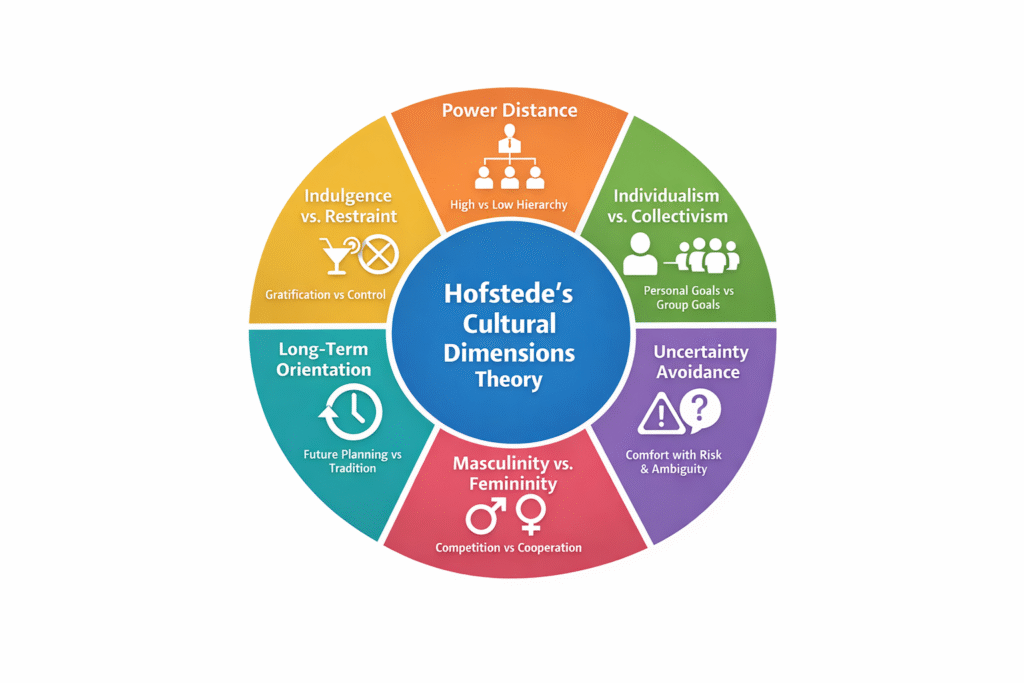 There are six dimensions in Hofstede’s theory:
- Power Distance (PDI): It refers to how comfortable people are with inequality in power. A high PDI indicates that people accept a hierarchical structure, following authority without question, whereas a low PDI suggests that people expect fairness and are willing to challenge authority or share power.
- Individualism vs. Collectivism (IDV): It refers to how people see themselves in relation to the group. Individualistic, means focusing on “I” and personal goals. Collectivist focuses on “we” and group goals. Extended family and community are very important.
- Uncertainty Avoidance (UAI): This refers to how comfortable people are with uncertainty or unknown situations. A high UAI means people prefer clear rules, structure, and certainty (They don’t like surprises.) A low UAI means people are more relaxed, flexible, and open to new ideas or risks.
- Achievement vs. Care (Masculinity vs. Femininity, MAS): Refers to what a society values more: success or relationships.
Masculine: Values success, competitiveness, and rewards for achievement.
Feminine: Values cooperation, caring, modesty, and quality of life. - Long-term vs. Short-term Orientation (LTO): Refers to how a society balances tradition and future planning.
Short-term: Values traditions, stability, and immediate results.
Long-term: Focuses on adaptability, planning for the future, and practical problem-solving. - Indulgence vs. Restraint (IND): It is an indication of how freely people enjoy life and satisfy desires.
Indulgent: Society allows fun, leisure, and personal enjoyment.
Restrained: Society controls gratification and emphasizes rules and discipline.
Here are these theories in action:
1. Walmart’s failure in Germany
Theory in Focus: Individualism (IDV) vs. Collectivism, Power Distance (PDI)
The Strategy: Walmart’s failure in Germany is a classic case of ignoring cultural dimensions. They attempted to impose a deeply American model on a culture with vastly different scores.
For example, when it comes to Low Individualism / High Collectivism, we find that Germany has a higher PDI and lower IDV than the US. That’s why Walmart’s mandatory “greeters” at the door and baggers at the checkout made pragmatic German customers deeply uncomfortable, perceiving it as forced friendliness and an invasion of personal space.
Another example could be find in the incopatability of the Low Power Distance index. Walmart’s US-style workplace practices clashed with local culture: mandatory morning exercises and motivational chants made employees uncomfortable, in addition to rules regulating personal relationships were seen as intrusive and patronizing.
This cultural misfit, among other operational errors, led to Walmart’s complete withdrawal from the German market after sustained losses. They failed to adapt their model to the local cultural context.
- McDonald’s: Adapting to Individualism
Theory in Focus: Individualism vs. Collectivism (IDV)
The Strategy: McDonald’s maintains its core brand identity (fast, consistent, family-friendly) but meticulously adapts its menu, marketing, and store experience to local cultural dimensions.
In High Collectivism Countries (e.g., China, Japan), marketing focuses on group harmony and sharing. Advertisements show families or friends enjoying a meal together. The menu features shareable items and group deals, de-emphasizing the hyper-individualized “Combo Meal” common in the West.
Based on these two contrasting cases, we can deduce that Hofstede’s cultural dimensions are not merely abstract academic concepts, but a critical predictive framework for global business strategy. The theory provides a powerful lens through which to anticipate the profound impact of deeply ingrained cultural values on consumer behavior and workplace expectations.